If you’re searching for IMU CET course options, you may already know that IMU CET is an important entrance route for several maritime programmes. But the bigger question is: Which course should you choose after 12th?
Should you go for DNS? B.Sc Nautical Science? B.Tech Marine Engineering? Naval Architecture? Ship Building?
These courses can lead to very different career paths.
Some are designed for students who want to work as deck officers on ships, while others prepare students for marine engineering, ship design, shipbuilding and maritime technical careers.
In this guide, we’ll explain the major IMU CET course options after 12th, what each course is about, how long it takes, who should choose it, and how the career path differs.
Important: The official IMU CET 2027 prospectus has not been released yet. The course information below is based on the latest official IMU information available for the 2026–27 admission cycle. Final 2027 eligibility, admission rules and course availability should be checked from the official IMU prospectus when released.
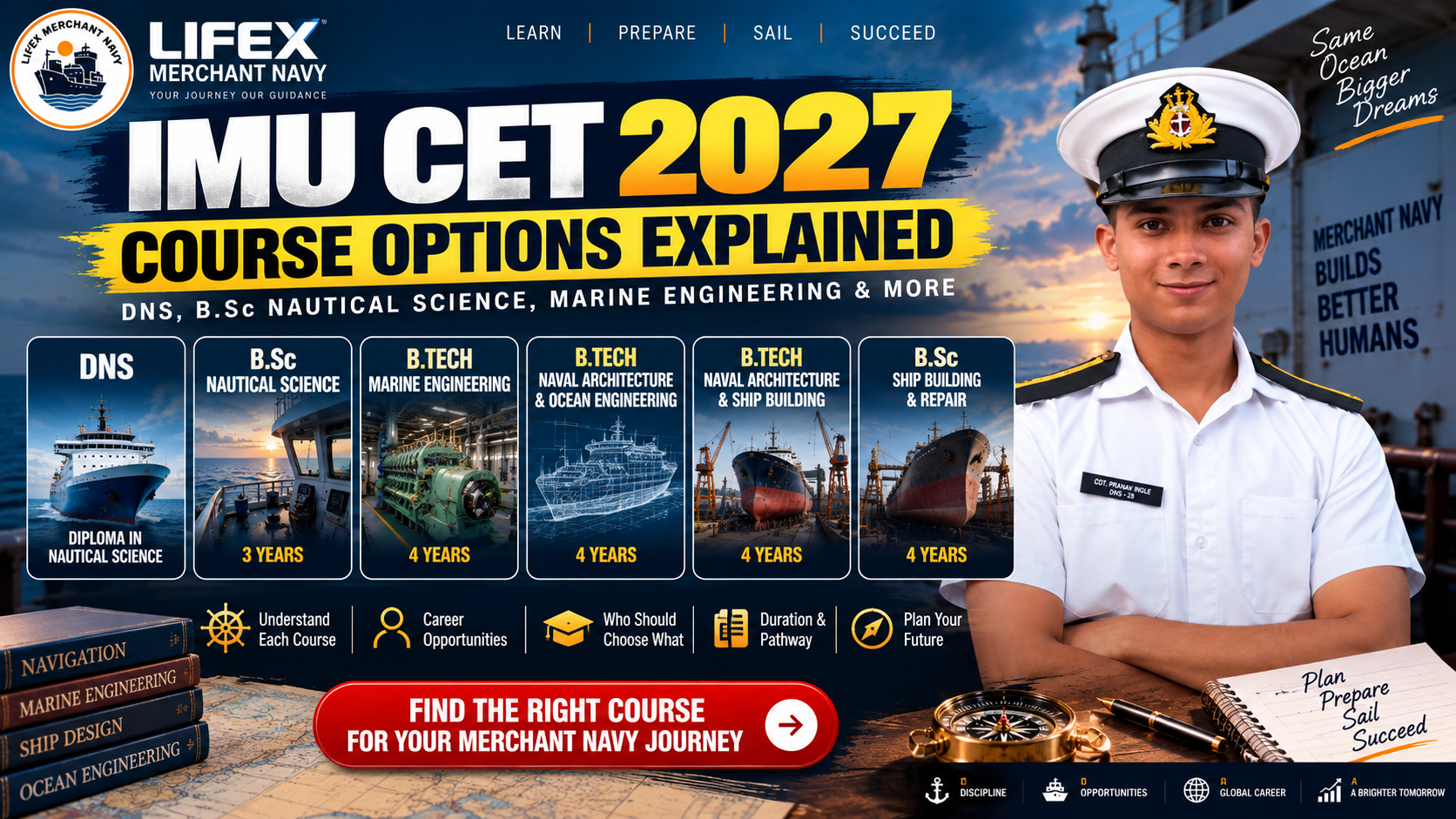
What Are the Course Options Through IMU CET?
For students coming from Class 12 with PCM, the major IMU-related options include:
- B.Sc Nautical Science
- Diploma in Nautical Science (DNS) leading to B.Sc Applied Nautical Science
- B.Tech Marine Engineering
- B.Tech Naval Architecture & Ocean Engineering
- B.Tech Naval Architecture & Ship Building
- B.Sc Ship Building & Repair
IMU also offers other undergraduate programmes such as BBA programmes in maritime logistics, but students interested specifically in the Merchant Navy sailing route usually focus more on DNS, B.Sc Nautical Science and B.Tech Marine Engineering.
So before choosing a course, first decide what kind of career you actually want.
Which IMU CET Course Is Best After 12th?
There is no single “best” IMU CET course for every student.
The right course depends on the career you want.
| Course | Duration | Main Career Direction |
|---|---|---|
| DNS | 1 Year | Deck Officer / Merchant Navy |
| B.Sc Nautical Science | 3 Years | Deck Officer / Merchant Navy |
| B.Tech Marine Engineering | 4 Years | Marine Engineer / Engine Department |
| B.Tech Naval Architecture & Ocean Engineering | 4 Years | Ship Design / Naval Architecture / Marine Industry |
| B.Tech Naval Architecture & Ship Building | 4 Years | Ship Design / Shipbuilding / Marine Industry |
| B.Sc Ship Building & Repair | 3 Years | Shipbuilding & Repair |
The important thing is that DNS and B.Sc Nautical Science are deck-side programmes, while B.Tech Marine Engineering is an engine-side programme.
That difference should be clear before you fill out an application.
What Is DNS in Merchant Navy?
DNS stands for Diploma in Nautical Science.
It is a 1-year residential programme leading to B.Sc. (Applied Nautical Science). IMU describes DNS as a programme covering marine navigation, seamanship and safety management, with the pathway leading towards the examinations required for a Certificate of Competency as a deck officer.
For a student who wants to become a deck officer in the Merchant Navy, DNS is one of the major routes to consider.
DNS at a glance
Duration: 1 year residential programme
Field: Nautical Science / Deck Department
Focus: Navigation, seamanship, safety and shipboard operations
Career direction: Deck Officer
Academic route: DNS leading to B.Sc. Applied Nautical Science
The DNS route can be attractive to students who want to enter the professional deck pathway through a relatively short academic programme before moving into the required sea-going training and certification pathway.
What Is B.Sc Nautical Science?
B.Sc Nautical Science is a 3-year residential undergraduate programme designed for students interested in the nautical/deck side of the Merchant Navy.
The programme covers areas related to navigation, ship operations, safety and nautical studies.
According to the latest IMU prospectus, admission to B.Sc Nautical Science is through IMU CET, and a valid IMU CET rank is required. The latest eligibility criteria include 10+2/equivalent with a minimum 60% average in PCM and at least 50% in English in 10th or 12th, subject to the other applicable conditions.
B.Sc Nautical Science at a glance
Duration: 3 years
Field: Nautical Science / Deck Department
Focus: Navigation, ship operations, safety and nautical subjects
Career direction: Deck Officer
Admission: IMU CET for the applicable admission cycle
If you want a degree-based route in Nautical Science rather than the one-year DNS academic route, B.Sc Nautical Science is an option worth understanding.
DNS vs B.Sc Nautical Science: What Is the Difference?
This is one of the most common questions students ask.
Both are connected with the deck side of the Merchant Navy, but their academic structure is different.
| Feature | DNS | B.Sc Nautical Science |
|---|---|---|
| Duration | 1 year | 3 years |
| Type | Diploma leading to B.Sc Applied Nautical Science | Degree |
| Department | Deck | Deck |
| Career Direction | Deck Officer | Deck Officer |
| Residential | Yes | Yes |
| IMU CET | Applicable | Applicable |
| Main Focus | Nautical training | Nautical degree + training |
The choice shouldn’t be made simply because one course is shorter.
You should consider the complete career pathway, training requirements, institute, sponsorship opportunities and your own long-term plans.
What Is B.Tech Marine Engineering?
If you don’t want to work in the deck department and are more interested in engines, machinery and technical systems, B.Tech Marine Engineering is the course you should understand.
B.Tech Marine Engineering is a 4-year residential undergraduate programme.
IMU describes the programme as focusing on marine machinery systems, marine engines, boilers, steam plants, marine simulators and other technical areas. Graduates can pursue careers as marine engineers on Indian and foreign-going ships.
B.Tech Marine Engineering at a glance
Duration: 4 years
Field: Marine Engineering
Department: Engine Department
Focus: Engines, machinery, electrical/technical systems, maintenance and shipboard engineering
Career Direction: Marine Engineer
Admission: IMU CET for the applicable admission cycle
For students who genuinely enjoy Physics, Mathematics, machines and technical problem-solving, this can be a strong career route.
B.Sc Nautical Science vs Marine Engineering
This is probably the most important comparison for a student interested in sailing.
| B.Sc Nautical Science | B.Tech Marine Engineering |
|---|---|
| Deck Department | Engine Department |
| Navigation-focused | Machinery-focused |
| Navigation & ship operations | Engines & technical systems |
| Deck Officer pathway | Marine Engineer pathway |
| 3 years | 4 years |
| More navigation/operations oriented | More engineering/technical oriented |
Think about it this way:
B.Sc Nautical Science → You learn how to navigate and operate the ship.
Marine Engineering → You learn how the ship’s machinery and engineering systems work and are maintained.
Neither is automatically “better.”
They are simply different careers onboard a ship.
What Is B.Tech Naval Architecture and Ocean Engineering?
Another IMU CET option is B.Tech Naval Architecture and Ocean Engineering.
This is a 4-year engineering programme focused on areas such as ship design, construction, offshore structures, marine engineering concepts and ocean-related engineering.
IMU’s current programme information describes it as a 4-year undergraduate engineering programme dealing with the design, construction, operation and maintenance of ships, offshore structures and marine vessels.
This is a different career direction from becoming a deck officer.
Students interested in:
- Ship design
- Engineering design
- Naval architecture
- Offshore structures
- Ship technology
- Technical and design careers
may find this route more suitable.
What Is B.Tech Naval Architecture and Ship Building?
B.Tech Naval Architecture and Ship Building is another 4-year undergraduate engineering option.
The programme covers areas related to:
- Ship design
- Ship construction
- Ship production
- Marine materials
- Ship machinery
- Hydrodynamics
- Structural analysis
- Ship repair and related technical areas
The latest IMU prospectus lists B.Tech Naval Architecture & Ocean Engineering and B.Tech Naval Architecture & Ship Building as 4-year residential programmes, with 10+2 PCM eligibility and IMU CET requirements for the applicable admission cycle.
If your interest is more towards building and designing ships rather than sailing them, this is a course you should research.
What Is B.Sc Ship Building and Repair?
IMU also lists B.Sc Ship Building & Repair among its undergraduate programmes.
This is a 3-year programme focused on the shipbuilding and ship-repair side of the maritime industry rather than the traditional deck-officer route. IMU’s published programme information lists 10+2/equivalent with PCM requirements and English requirements for this course.
One important point: IMU’s FAQ notes that this programme is conducted through an IMU-affiliated institute.
So students should check the current admission notification and institute details before making a decision.
Which IMU CET Course Is for Deck Officer?
If your goal is to become a Deck Officer, the two major options you should understand are:
DNS
Diploma in Nautical Science
and
B.Sc Nautical Science
Both are connected to the nautical/deck side of the Merchant Navy.
DNS is a 1-year residential programme leading to B.Sc Applied Nautical Science, while B.Sc Nautical Science is a 3-year degree programme.
Which IMU CET Course Is for Marine Engineer?
If your goal is to become a Marine Engineer, the relevant undergraduate programme is:
B.Tech Marine Engineering
It is a 4-year residential engineering programme focused on ship machinery, engines and technical systems.
A Marine Engineer works primarily with the technical and engineering side of the vessel rather than navigation.
Which IMU CET Course Is for Ship Design?
If your interest is in designing and building ships rather than sailing as a deck or engine officer, look at:
- B.Tech Naval Architecture & Ocean Engineering
- B.Tech Naval Architecture & Ship Building
- B.Sc Ship Building & Repair
These programmes move you towards the ship design, construction, repair and marine engineering industry rather than the conventional deck-officer route.
Which Course Is Better: DNS or Marine Engineering?
There is no universal answer.
The better question is:
“Which type of work do I want to do?”
Choose DNS if you are interested in:
- Navigation
- Deck operations
- Ship handling
- Communication
- Leadership
- Nautical operations
- Becoming a Deck Officer
Consider Marine Engineering if you are more interested in:
- Engines
- Machines
- Mechanical systems
- Troubleshooting
- Maintenance
- Engineering
- Technical problem-solving
Your personality and interests matter here.
A student who loves machines may struggle in a navigation-focused career, while someone who enjoys navigation and operational responsibility may not enjoy spending most of their time dealing with engineering systems.
Which Course Is Best for Merchant Navy After 12th?
If by “Merchant Navy” you specifically mean working onboard a commercial ship, the main courses students usually compare are:
DNS → Deck
B.Sc Nautical Science → Deck
B.Tech Marine Engineering → Engine
These are the three courses that deserve the most attention from a Class 12 PCM student who wants a sea-going career.
The other IMU programmes can also lead to strong maritime careers, but they are more closely connected to areas such as ship design, shipbuilding, repair, offshore engineering and the wider maritime industry.
What Are the Eligibility Requirements for These IMU Courses?
The exact requirements can differ by programme.
For the latest 2026–27 cycle, B.Tech Marine Engineering requires 10+2/equivalent with a minimum 60% average in PCM and at least 50% in English in 10th or 12th, along with the other applicable conditions and a valid IMU CET rank.
For B.Sc Nautical Science, the latest official criteria similarly specify 60% average in PCM, 50% English and other conditions such as age, marital status, medical fitness and a valid IMU CET rank.
For B.Tech Naval Architecture & Ocean Engineering and B.Tech Naval Architecture & Ship Building, the latest criteria include 60% average in PCM, 50% English and a valid IMU CET rank.
Students should always verify the final requirements in the 2027 prospectus when it is released.
Do All IMU Courses Require IMU CET?
Not every IMU programme uses exactly the same admission route.
IMU’s current FAQ states that, with exceptions including BBA (Logistics, Retailing & E-Commerce) and PGDME, programmes generally require a rank in the All India Common Entrance Test, subject to the applicable academic brochure.
For the major programmes discussed in this article, the latest official prospectus confirms IMU CET-based admission for B.Sc Nautical Science, DNS and B.Tech programmes.
This is another reason why students should identify the exact course before preparing for the entrance exam.
Can I Choose DNS After Class 12?
Yes.
DNS is specifically designed as a post-12th route for eligible students with PCM.
The latest official IMU information lists 10+2/equivalent with a minimum 60% average in PCM and 50% English as the key academic requirement for DNS, along with other conditions.
If your goal is the deck side of the Merchant Navy and you are comfortable with a residential one-year DNS route, it is one of the major options to consider.
Can I Choose Marine Engineering After Class 12?
Yes.
Students with PCM can apply for B.Tech Marine Engineering if they meet the prescribed eligibility requirements.
The current IMU programme information specifies:
10+2 with PCM
60% average in PCM
50% English
along with other admission requirements.
What Should I Choose If I Am Good at Physics and Mathematics?
Being good at Physics and Mathematics is useful for almost all technical IMU CET options, but your interests should decide the final course.
If you enjoy:
Physics + Machines + Engineering → Marine Engineering
Navigation + Operations + Leadership → Nautical Science / DNS
Design + Engineering + Ships → Naval Architecture
Ship Construction + Repair → Ship Building & Repair
This simple way of looking at the options can make the decision much easier.
What Should Parents Know Before Choosing an IMU Course?
Parents often focus on one question:
“Which course has the best salary?”
That’s understandable, but it shouldn’t be the first question.
First understand:
Course → Career → Training → Sea-going/shore-based pathway → Sponsorship → Growth
A student choosing the wrong course because someone said “this course has more scope” can end up spending years in a field they don’t enjoy.
The right course should match the student’s interest, academic strengths, medical suitability and long-term career plan.
What Is the Difference Between Deck and Engine Department?
This is the easiest way to understand the Merchant Navy courses.
Deck Department
The deck side deals with areas such as:
- Navigation
- Ship operations
- Cargo operations
- Safety
- Communication
- Watchkeeping
- Ship handling
Typical pathway:
DNS / B.Sc Nautical Science → Deck Cadet → Officer → Senior Officer
Engine Department
The engine side deals with:
- Main engines
- Auxiliary machinery
- Pumps
- Boilers
- Electrical/technical systems
- Maintenance
- Troubleshooting
Typical pathway:
B.Tech Marine Engineering → Trainee/Junior Engineer pathway → Marine Engineer → Senior Engineer
The exact career progression depends on training, certification, sea time and applicable regulations.
Is Sponsorship Important for DNS and Nautical Science?
For students targeting the deck-side Merchant Navy route, sponsorship can be an important part of the overall admission and career planning process.
However, IMU admission and company sponsorship are not the same thing.
IMU CET is an entrance/admission pathway.
Sponsorship is connected with a shipping company and its selection process.
That means a student should understand both:
IMU CET preparation + Sponsorship preparation
This is one reason why students shouldn’t stop preparing immediately after getting an IMU CET rank.
Is Sponsorship Required for Marine Engineering?
Sponsorship and admission should again be treated as separate processes.
A student may need to understand the admission requirements of the course and separately research company sponsorship opportunities, depending on the career route and institution/company.
The exact process can vary by company and admission cycle.
How Should I Choose My IMU CET Course?
Use this simple decision framework.
Step 1: Ask Yourself — Do I Want to Sail?
If yes, look closely at:
DNS / B.Sc Nautical Science / B.Tech Marine Engineering
Step 2: Decide Your Department
Navigation → Deck
Machines → Engine
Step 3: Check Your Eligibility
Verify:
- PCM percentage
- English marks
- Age
- Medical requirements
- Course-specific conditions
Step 4: Understand the Career Path
Don’t choose a course only because someone told you it is “best.”
Understand what you’ll actually study and what kind of work you’ll do after graduation.
Step 5: Research Training and Sponsorship
Look beyond the college name.
Check the training structure, institute reputation, company connections, sponsorship opportunities and career support.
IMU CET Course Selection Mistakes Students Should Avoid
Choosing a Course Only Because It Is Shorter
DNS is shorter academically, but that doesn’t automatically make it better.
Choosing Marine Engineering Without Understanding the Engine Department
Marine Engineering is a technical career. Students should be comfortable with engineering and machinery.
Confusing IMU CET With Sponsorship
They are different parts of the overall journey.
Choosing Based Only on Salary Claims
Career progression depends on many factors including certification, sea time, company, role and performance.
Ignoring Medical Requirements
For relevant sea-going programmes, medical fitness is a major consideration.
Following Friends
Your friend’s ideal course may not be your ideal course.
Which IMU CET Course Should You Choose? Quick Decision Guide
Want to become a Deck Officer?
→ DNS / B.Sc Nautical Science
Want to become a Marine Engineer?
→ B.Tech Marine Engineering
Interested in ship design and naval architecture?
→ B.Tech Naval Architecture & Ocean Engineering
Interested in shipbuilding and construction?
→ B.Tech Naval Architecture & Ship Building
Interested in shipbuilding and repair?
→ B.Sc Ship Building & Repair
This is a starting point, not a substitute for checking the detailed curriculum and official eligibility.
Why IMU CET Preparation Should Start Early
Once you decide your course, your preparation becomes much more focused.
For the major technical IMU CET route, students need to prepare subjects such as:
The latest official UG Technical pattern contains 200 MCQs and is based around the senior-secondary level.
But preparation isn’t only about completing the syllabus.
Students also need:
Concepts → MCQ Practice → Revision → Mock Tests → Exam Strategy
This is where structured preparation can make a difference.
At LifeX Merchant Navy, the focus can go beyond simply preparing students for an entrance test. The bigger goal is to help students understand the complete pathway — from choosing the right course to preparing for IMU CET, sponsorship and the next stages of their Merchant Navy career.
IMU CET Courses After 12th: Quick Comparison
| Course | Duration | Department / Field | Best For |
|---|---|---|---|
| DNS | 1 Year | Deck | Students targeting Deck Officer pathway |
| B.Sc Nautical Science | 3 Years | Deck | Students wanting a degree-based nautical route |
| B.Tech Marine Engineering | 4 Years | Engine | Students interested in marine machinery & engineering |
| B.Tech NAOE | 4 Years | Naval Architecture | Ship design & ocean engineering |
| B.Tech NASB | 4 Years | Ship Building | Ship design & construction |
| B.Sc Ship Building & Repair | 3 Years | Shipbuilding | Ship repair & construction |
Course duration and admission details above are based on the latest official IMU information available for the current admission cycle.
Frequently Asked Questions About IMU CET Course Options
Which courses can I choose through IMU CET after 12th?
Major options include B.Sc Nautical Science, DNS, B.Tech Marine Engineering, B.Tech Naval Architecture & Ocean Engineering and B.Tech Naval Architecture & Ship Building, along with other IMU undergraduate programmes depending on the admission cycle.
Which IMU CET course is best for Merchant Navy?
For a sea-going Merchant Navy career, the main courses students compare are DNS, B.Sc Nautical Science and B.Tech Marine Engineering. The right choice depends on whether you want to work in the deck or engine department.
Which course is best for becoming a Deck Officer?
DNS and B.Sc Nautical Science are the main deck-side options to consider.
Which course is best for becoming a Marine Engineer?
B.Tech Marine Engineering is the relevant undergraduate engineering route for students targeting a Marine Engineer career.
Is DNS better than B.Sc Nautical Science?
Neither is automatically better. DNS is a 1-year residential programme leading to B.Sc Applied Nautical Science, while B.Sc Nautical Science is a 3-year undergraduate degree. Your career plan and preferred route should decide the choice.
Is Marine Engineering better than Nautical Science?
They are different career paths. Nautical Science is focused on the deck department and navigation, while Marine Engineering is focused on engines, machinery and technical systems.
What is the duration of DNS?
The DNS programme is 1 year and residential.
What is the duration of B.Sc Nautical Science?
B.Sc Nautical Science is a 3-year residential undergraduate programme.
What is the duration of B.Tech Marine Engineering?
B.Tech Marine Engineering is a 4-year residential undergraduate engineering programme.
Can I do Marine Engineering after 12th?
Yes. Students with the required PCM subjects and marks can pursue B.Tech Marine Engineering, subject to the applicable IMU admission requirements.
Can I do DNS after 12th?
Yes. DNS is one of the post-12th routes for eligible PCM students who want to pursue the nautical/deck side of the Merchant Navy.
Is IMU CET mandatory for DNS?
For the latest admission cycle, IMU states that admissions to B.Sc Nautical Science and DNS are conducted through IMU CET and that IMU CET is mandatory.
Is IMU CET mandatory for B.Tech Marine Engineering?
The latest IMU prospectus states that admissions to B.Tech programmes are conducted through IMU CET, and B.Tech Marine Engineering requires a valid IMU CET rank.
What if I don’t want to sail?
You can explore courses such as Naval Architecture, Ship Building & Repair and other maritime/logistics programmes that can lead towards shore-based and technical careers in the maritime industry. IMU offers multiple undergraduate programmes beyond the traditional sailing routes.
Is IMU CET 2027 course information officially released?
The official 2027 prospectus has not yet been released. The information in this article is based on the latest official IMU information available for the 2026–27 admission cycle.
Final Takeaway
Choosing an IMU CET course is a much bigger decision than simply asking “Which course has the highest salary?”
First decide what kind of career you want.
Want the Deck Department?
Look at DNS or B.Sc Nautical Science.
Want the Engine Department?
Look at B.Tech Marine Engineering.
Want Ship Design or Shipbuilding?
Explore Naval Architecture and Ship Building programmes.
And if you’re still confused, don’t choose based on a random YouTube video, a friend’s opinion or an advertisement.
Understand the course, eligibility, training, career path and your own strengths first.
Then start preparing.
For students targeting the Merchant Navy after Class 12, the journey isn’t just about clearing IMU CET. It’s about making the right decision at each stage — course selection, entrance preparation, sponsorship preparation, communication skills and career planning.
That’s where structured guidance can help.
LifeX Merchant Navy focuses on helping students prepare for the IMU CET pathway while also understanding the wider Merchant Navy career journey. for location click here
DNS vs B.Sc Nautical Science 2027: Which Is Better?
IMU CET 2027 | MERCHANT NAVY COURSE GUIDE DNS vs B.Sc...
Read More

Best Online IMU CET Coaching 2027: How to Choose the Right Batch
IMU CET 2027 | ONLINE PREPARATION GUIDE Best Online IMU CET...
Read More
IMU CET Course Options Explained: DNS, B.Sc Nautical Science, Marine Engineering & More
If you’re searching for IMU CET course options, you may already...
Read More
IMU CET Eligibility Criteria After 12th 2027: Age, PCM Marks, English & Medical Requirements
IMU CET eligibility criteria after 12th 2027 are one of the...
Read More
IMU CET Exam Pattern and Syllabus 2027: Complete Guide
IMU CET exam pattern and syllabus 2027 are two of the...
Read More
What Is IMU CET Exam? Complete Guide for Merchant Navy Aspirants
What is IMU CET exam? IMU CET stands for Indian Maritime...
Read More
Best IMUCET & Merchant Navy Coaching in Gurugram
If you’re looking for the Best IMUCET & Merchant Navy Coaching...
Read More
IMUCET Previous Year Question Papers – Solved PYQs & Complete Exam Analysis
Apart from studying the complete syllabus, preparation for IMUCET exam also...
Read More
Best Merchant Navy Coaching Institute in India for IMUCET 2027
Best Merchant Navy Coaching Institute in India for IMUCET 2027 If...
Read More
“IMUCET 2027 Preparation: Best Study Plan Guide”
If you want to build a career in the Merchant Navy...
Read More
IMUCET 2026 Exam Dates Announced – Complete Registration, Exam & Preparation Guide
The IMUCET 2026 exam dates have been officially announced, bringing clarity...
Read More
Best IMUCET Coaching in India – Complete Selection Guide for Merchant Navy Aspirants
Best IMUCET coaching in India helps students crack IMUCET and clear...
Read More
One Response